The free document from the Affiliate World Budapest talk
The Purple Ocean Engine
How we produce multiple 7-figure advertorials with AI — without creating slop, or lying through our teeth.
Every framework. Every prompt. Every study citation. Written down step by step, one level deeper than the stage version — so you can ship your first high-level advertorial this week. Free, no email gate.
Moritz Frankl · Founder, ecomtorials 500+ advertorial funnels built. Advertorials are all we do.
↓The full system, step by step. Scroll.
Read this first
Everything I promised on stage. Nothing held back.
You scanned a QR code in Budapest — or someone who did sent you this link. Either way: this is the full system from the talk, written down so you can run it.
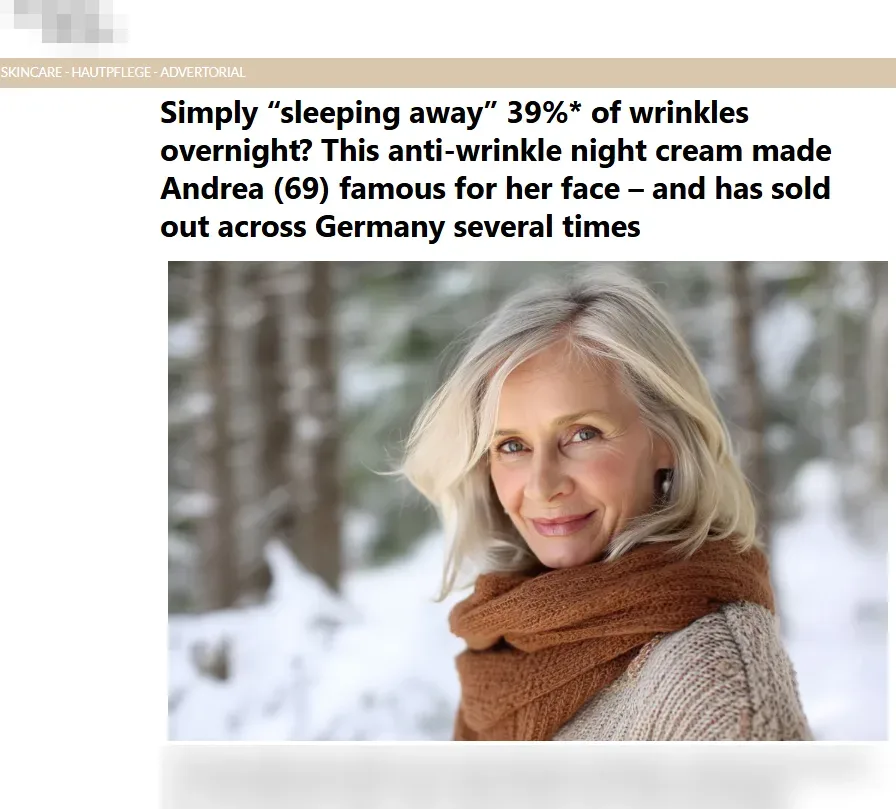
The advertorial I opened the talk with has done over €18,000,000 in revenue to date — and it took about two hours to build, using AI. Not because of a magic prompt, but because of the system behind it. This page is that system.
The one from stage: a single advertorial, €18M+ attributed revenue to date. Built in ~2 hours with the system on this page.
On stage I had 25 minutes. That was enough to show you what the Purple Ocean Engine is and why it works. It was not enough for the hands-on parts: the research workflow, the exact prompts, the tool decisions. That's what this page is for. If you were in the room, the three steps will feel familiar — but every section here goes one level deeper than the stage version, and everything you need to execute is included.
One promise before we start, because it's the same promise the whole system is built on: every number on this page comes from published research. Every study is cited with its PMID in the appendix, and you can verify each one on PubMed in ten seconds. The system preaches "no source, no sentence" — so this page practices it.
Throughout, we'll use the same worked example from the talk: a (fictional) cushioned work shoe for women who spend their entire workday on their feet — nurses, kindergarten teachers, hairdressers, cashiers. The product is invented. Every study behind it is real.
The market in 2026
Every vertical is a red ocean — and AI made it worse
Supplements, beauty, health, food — whatever vertical you're in, whatever GEO: countless competitors, rising customer acquisition costs, dropping AOVs. Proven demand, brutal competition. That's the red ocean, and in 2026 there is no escaping it by "finding a niche" the old way.
Then AI accelerated everything. For years, the players with the highest creative output won. That edge is gone: everyone can pump out a new campaign in 30 seconds now. Output multiplied across the whole market — and quality collapsed. If your performance is dropping even though you're producing more than ever — that's this, not your media buying.
The root cause: AI doesn't give you the best content
Here's the technicality you need to understand, because the entire system is built on it. A language model was never designed to give you the best content. It's trained to predict the most probable next word — and "probable" means: what it has seen most often. So by default, AI gives you:
the most probable,
the most average,
the most seen-before.
Prompt:"Your skin deserves ___"
the best
82%
real results
46%
to glow
28%
a miracle
14%
The model always reaches for the tallest bar — the most common phrase. The same phrase your competitor's model reaches for, because it's the same model.
So when people brag "with AI I produce ten times more, ten times faster," they're producing ten times more of the most average thing on the internet — the same five angles, the same voice, written by them AND their competition, from the same model. And "most seen-before" also means: most seen before by your audience. That is the real cost of slop — not that it's bad writing, but that it makes everyone sound identical.
The flip
Your competition uses AI to go faster. Use AI to go deeper — more specific, more relevant than anyone in your market can even afford to be. Because while everyone keeps screaming the same average message at the same saturated mass market, AI just made something profitable that was unthinkable before.
The opening
Red, blue… and purple
You know red ocean and blue ocean. Red: proven demand, brutal competition — you fight everyone on price and CPMs. Blue: no competition, which usually means no market — and a fortune spent educating people about a problem they don't know they have.
There's a third color. Purple: a specific, underserved micro-segment sitting right inside the red ocean. A blue ocean hiding inside your red ocean. (And no — "purple ocean" isn't my invention either; it comes from strategy people who realised blue oceans never stay blue. Everything gets copied, and in the AI era it gets copied instantly.)
RED
Proven demand, but brutal competition. You outbid fifty advertisers for the same eyeballs.
BLUE
No competition — but likely no demand. You pay to educate people about a problem they don't know they have.
PURPLE
Proven demand — and nobody speaks to these exact people. You skip the most expensive part of each.
Purple inherits the good half of each:
From red you inherit proven demand. You never have to educate anyone that the problem exists. She already knows her back hurts; she's already been buying solutions.
From blue you inherit no direct competition. Nobody speaks to these exact people directly, so there's no CPM war for their attention.
Purple ocean = red-ocean market × specific sub-identity
"Back pain" is as red as an ocean gets — everyone from pharma to yoga apps is in it. But back pain × "women who are on their feet all day for a living" is a purple ocean: massive, proven demand — and almost nobody speaks to her specifically. To that woman, your advertorial isn't another back-pain product. It's the first one that seems to understand her actual day.
Why now? Because it never paid — until AI collapsed the cost
Nobody targeted these micro-audiences before because it simply didn't pay. A properly researched advertorial for a micro-segment used to take a team days, sometimes weeks — and you couldn't even be sure it would work until the end. You can't justify that for a segment of eighty thousand people. AI took that cost to near zero. What was economically impossible is suddenly profitable — lower CPMs because nobody talks to these exact audiences, lower CACs, higher AOVs. (With Meta's Andromeda it got even better; more on that in Step 2.)
That's the entire window the Purple Ocean Engine exploits. And it's open now.
The system
The Purple Ocean Engine — three steps
If this system converts deeply skeptical Germans at scale — and it does, we run it in the arguably toughest market in the world — it will convert your traffic too. Whatever GEO, whatever vertical.
I've broken it down into three steps you can steal from me today:
Six copy-paste prompts are embedded along the way — research (1, 2, 3), purple-ocean discovery (4), voice-of-customer clustering (5) and the full editorial rewrite (6).
1
Break the old belief. Install a new one.
The Unique Mechanism — what converts. The belief-shift chain, the break-and-install logic, and how to build it on published science instead of hype. With the exact prompts.
1.1Your prospect is burned — and her bullshit-o-meter is on
Whatever your vertical: your prospect is not a fresh, hopeful buyer anymore. False and exaggerated promises, bad products, and solutions that simply didn't work for her have made her deeply skeptical. She has bought product after product that promised to fix her problem — and every one let her down. By now she has a built-in bullshit-o-meter, and it is very, very sensitive.
I learned to convert skeptics in the hardest room on earth: Germany. You cannot just tell a German something about your product and expect them to throw money at you. You have to deeply convince us. You have to prove it — and prove it well, or we simply won't believe you. Converting ice-cold traffic on first click is already hard; doing it with Germans is the final boss. Master that, and the discipline transfers to any GEO.
This is why it's not enough to sell "the old way." To convert these prospects you have to break an old belief system they hold, and install a new one. And you do this best with logic, science and truth.
Truth beats scam. 24/7.
Watch what many marketers do when things get tough: they drift to the dark side. Here a fake doctor, there an invented study, everywhere claims screamed a little louder. And aside from the ethical problem — it doesn't even work better. Your prospect's bullshit-o-meter smells it from miles away. Louder just proves you're one more liar.
That's why I defend one sentence like a religion: truth beats scam, 24/7. It doesn't just feel better — with AI, it now also works better and faster. And it does something brutal to your competition: when you show up with a real mechanism and a real study, every competitor running a vague claim suddenly looks like a scammer next to you. You don't attack them. You don't even mention them. You raise the standard of proof, and everyone who can't meet it disqualifies themselves.
The scam playbook ✗
The truth playbook ✓
Louder claims
Real published studies
Fake urgency & timers
The real root cause
Invented "studies"
Logic she can follow
"Clinically proven" (by whom?)
Treat her like an adult
1.2The chain every advertorial runs on
Every advertorial that works is the same machine under the hood — one specific chain:
PROBLEM
→
FAILED SOLUTIONS
→
ROOT CAUSE
→
UNIQUE MECHANISM
→
OFFER
The belief shift happens here ↑ — root cause hands over to mechanism
PROBLEM — open on her pain. Concrete, specific, her actual day. Not "back pain" — "by the end of every shift, her lower back is done."
FAILED SOLUTIONS — everything she's already tried, and why it let her down. Name them. She needs to see her own history on the page.
ROOT CAUSE — the real, physical reason nothing worked. The thing none of the failed solutions ever touched.
UNIQUE MECHANISM — how your solution addresses that root cause, logically, where the others physically couldn't.
OFFER — only now: why you, why now, what her life looks like after.
The two rules of the chain
Never skip a link. Jump from pain straight to mechanism and she has no reason to believe this time is different. Never mix links. Selling inside the root-cause section kills the "honest diagnosis" frame you just built.
Knowing the chain is table stakes — every decent copywriter knows some version of it, and there are countless winning advertorials out there you can swipe for structure. The edge is understanding that the whole chain exists to produce one moment: the belief shift, right at the center, where ROOT CAUSE hands over to MECHANISM. If you get the unique mechanism right, that's 80% of the work. That moment is what we build now.
1.3The worked example: three numbers, one belief shift
Meet your hardest prospect. She's 41, a nurse. Ten-hour shifts, almost all of it on her feet. By the end of every shift her lower back is screaming. She's tried painkillers, physio on her days off, an expensive new mattress. Nothing really moved it. So she carries one firm belief:
"My back is just wrecked from work. Nothing helps — that's the job."
That belief is the wall between you and the sale. You can't climb it by shouting your claim louder — she's heard "fix your back pain" a hundred times. Break the wall instead. A belief shift has exactly two halves:
BREAK the old belief (failed solutions + root cause): show her why everything she tried couldn't work — not because she's unlucky, but because of a root cause none of them ever touched. Her belief moves from "nothing works" to "everything I tried couldn't work."
INSTALL the new belief (mechanism): show her, logically, why your solution works where the others physically couldn't.
Here are both halves live, running on published research and nothing else. Our fictional product: orthopedic work shoes against back pain. Note that the mechanism doesn't revolve around back pain in general — it revolves around back pain from standing too long. That specificity is everything.
71
Minutes
of continuous standing until the average person develops clinically relevant back pain
Coenen et al. 2017 · PMID 28863405
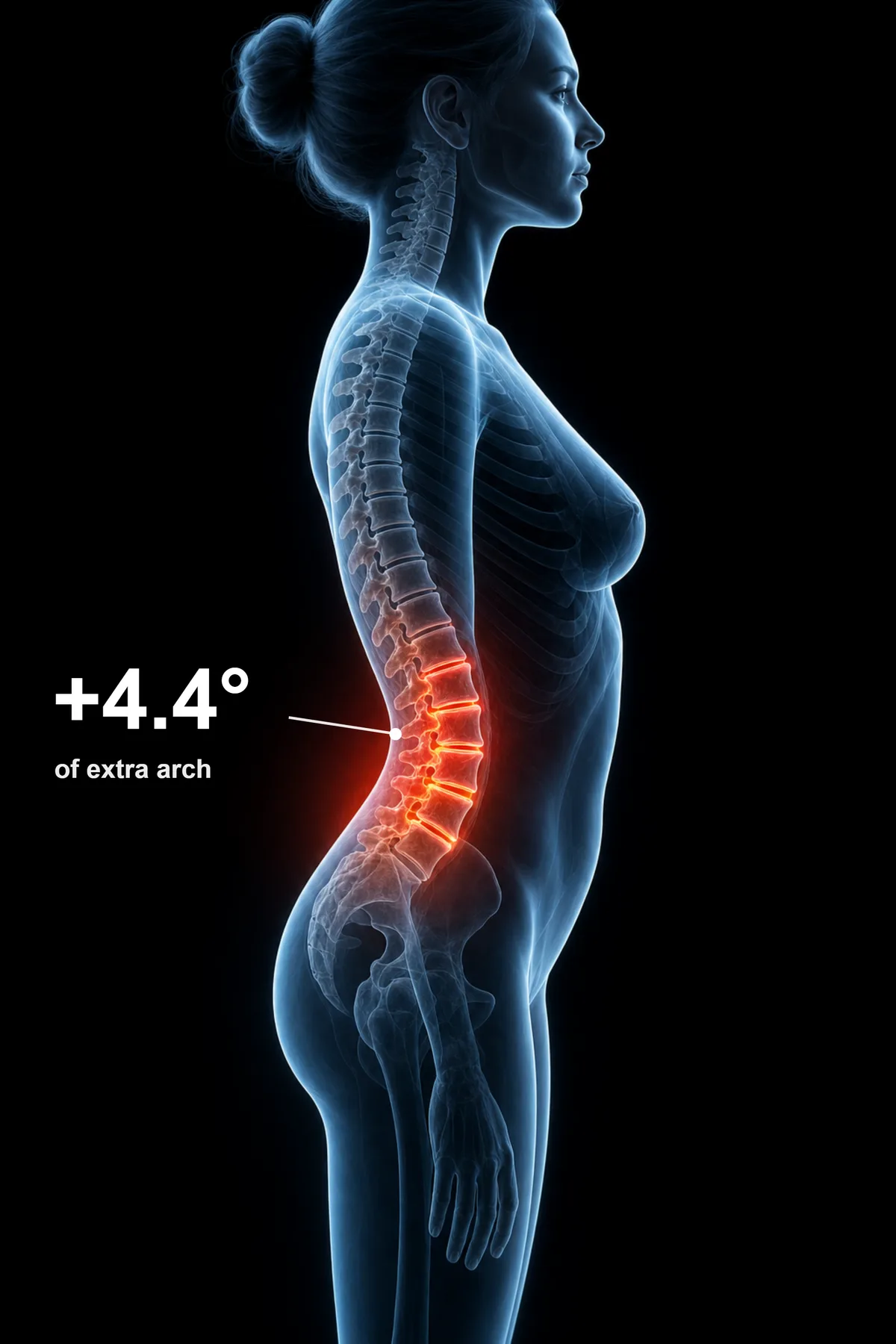
4.4°
of arch
the entire difference between pain and no pain when standing
Sorensen et al. 2015 · PMID 25637464
−47%
Pain
same person, same standing time — cushioned ground under the foot halves the perceived pain
Winberg et al. 2022 · PMID 34837750
The root cause, visualized: ~4.4° of extra hollow-back after about an hour of standing — the entire difference between pain and no pain.
THE PAIN, quantified — the Unique Mechanism of Problem. A systematic review of laboratory studies found that the average person develops clinically relevant low-back symptoms after about 71 minutes of continuous standing (Coenen et al. 2017). People prone to standing-induced back pain get there even faster — around 42 minutes (Khoshroo et al. 2023). A cashier hits that before her first break. And the root cause is almost absurdly small: after about an hour of uninterrupted standing, your body sinks into a hollow-back of about 4.4 degrees — and this tiny postural shift overloads the small joints of the spine and creates measurable back pain (Sorensen et al. 2015). Not a weak back. Not bad luck. A few degrees of posture, hour after hour.
THE BREAK. Now watch what that root cause does to everything she tried: the painkiller numbs the signal — but she's still standing at those extra degrees. The physio session on Sunday can't fix the eight hours she stands on Monday. The mattress? She's not in pain lying down — she's in pain standing. None of them ever touched the root cause. Old belief broken: it's not her fault; everything she tried was aiming at the wrong target.
THE INSTALL — the Unique Mechanism of Solution. If the strain builds through the hard ground under her feet all day, change what's under her feet. In controlled studies, a cushioned surface cut perceived standing back pain by about 47% in exactly the people who develop it — same person, same standing time, only the ground changed (Winberg et al. 2022; supported by Aghazadeh et al. 2015). Our fictional shoe is that cushioning, carried with her all day — working during the shift, where painkillers, physio and mattress only act after it.
And now watch what happens, purely from turning study facts into your mechanism. She finally understands where her back pain really comes from (the 4.4° arch). She understands why no other solution could ever help her — the root cause was never fixed. And your product becomes the only logical solution: she now knows only cushioning under her feet, during the shift, will ever fix her standing pain. And guess who has an absolute no-brainer offer ready for her on this same page where she just understood all of this. (You.)
Her years of disappointment now make sense, and every failed fix becomes proof for the new mechanism. That's the most beautiful judo move in direct response — her skepticism starts working for you.
What we deliberately do NOT claim (and neither should you)
This is the discipline that makes the mechanism unbreakable under scrutiny. The same studies that give you the three numbers also draw the boundaries:
✗"Standing causes chronic back conditions." The clean evidence is for acute, experimentally induced standing pain (minutes to hours). Whether standing causes chronic low-back pain is scientifically contested (Swain et al. 2020: "no consensus regarding causality"; Jahn et al. 2023 found no association for standing alone). Sell the acute, daily problem — it's real, measurable, and hers.
✗"Insoles are proven to halve standing back pain." The −47% comes from anti-fatigue mats — cushioned ground. A randomized trial of standard orthotic insoles found they did not prevent back pain (Mattila et al. 2010). That's exactly why the product framing is "portable anti-fatigue cushioning," not "orthopedic arch support."
✗Objective-sounding language for subjective findings. The pain reduction was measured as self-reported pain. Say "perceived pain" or "reported pain" — it's what the studies say, and it's still exactly what she feels.
✓Allowed and strong: "Uninterrupted standing drives most people into measurable back pain within about 71 minutes; a few degrees of hollow-back posture make the difference; and cushioned ground under the feet roughly halves the perceived pain in exactly the people affected — while painkillers, physio and mattresses only act after the shift."
Notice: the honest version is not weaker. It's sharper — because it survives the one reader who checks, and because precision itself signals credibility to everyone who doesn't.
1.4How to find YOUR mechanism — with Claude and the actual science
This is the part I could only tease on stage. It's simpler than you think — four steps, one discipline.
1
Start from the symptom
Take your prospect's pain in her own words: "my back hurts after standing all day." Not your product's feature list — her symptom.
2
Ask the question nobody asks
WHY, physically, does that happen? What is the root cause? Not "what does my product do" — what actually goes wrong in her body, her skin, her sleep, her dog's joints?
3
Pull the real studies — Claude + a scientific connector
You don't ask AI to make something up. You connect Claude to the actual research literature and pull real, published studies. The studies are the data — AI only condenses them.
4
Pull the citation FIRST — then write
No source, no sentence. The citation file comes before the copy. Ever notice how much easier it is to write persuasively when you're not making anything up?
The connector workflow (what I showed on stage)
Claude supports connectors — integrations that let it search external databases directly instead of answering from memory. Several free scientific connectors give Claude live access to research databases like PubMed (the U.S. National Library of Medicine's index of medical literature: free, public, no login — pubmed.ncbi.nlm.nih.gov). In Claude, open Settings → Connectors, browse the directory for a PubMed / scientific-literature connector, and enable it.
Then the workflow is exactly what you saw on stage:
Give Claude your customer avatar — for us: "people with back pain from standing too long."
Ask it to search the literature for the root cause of that symptom and to build your Unique Mechanism of Problem and Unique Mechanism of Solution — citing every study it uses with its PMID (Prompt 1 below).
Verify each PMID yourself. Open every citation on PubMed and check that the abstract actually says what the mechanism claims (Prompts 2 and 3). Claude found the studies behind our three numbers within minutes — but the numbers only went on stage after each abstract was read.
No connector available, or you're working outside medicine? Do the same thing manually: search PubMed or Google Scholar with 3–5 search strings built from symptom + population + suspected mechanism (e.g. "prolonged standing low back pain", "lumbar lordosis standing pain development", "anti-fatigue mat low back pain"), filter for meta-analyses and systematic reviews first, hunt the abstracts for concrete numbers — minutes, degrees, percentages. Small precise numbers ("4.4 degrees") persuade better than big vague ones ("up to 90%!").
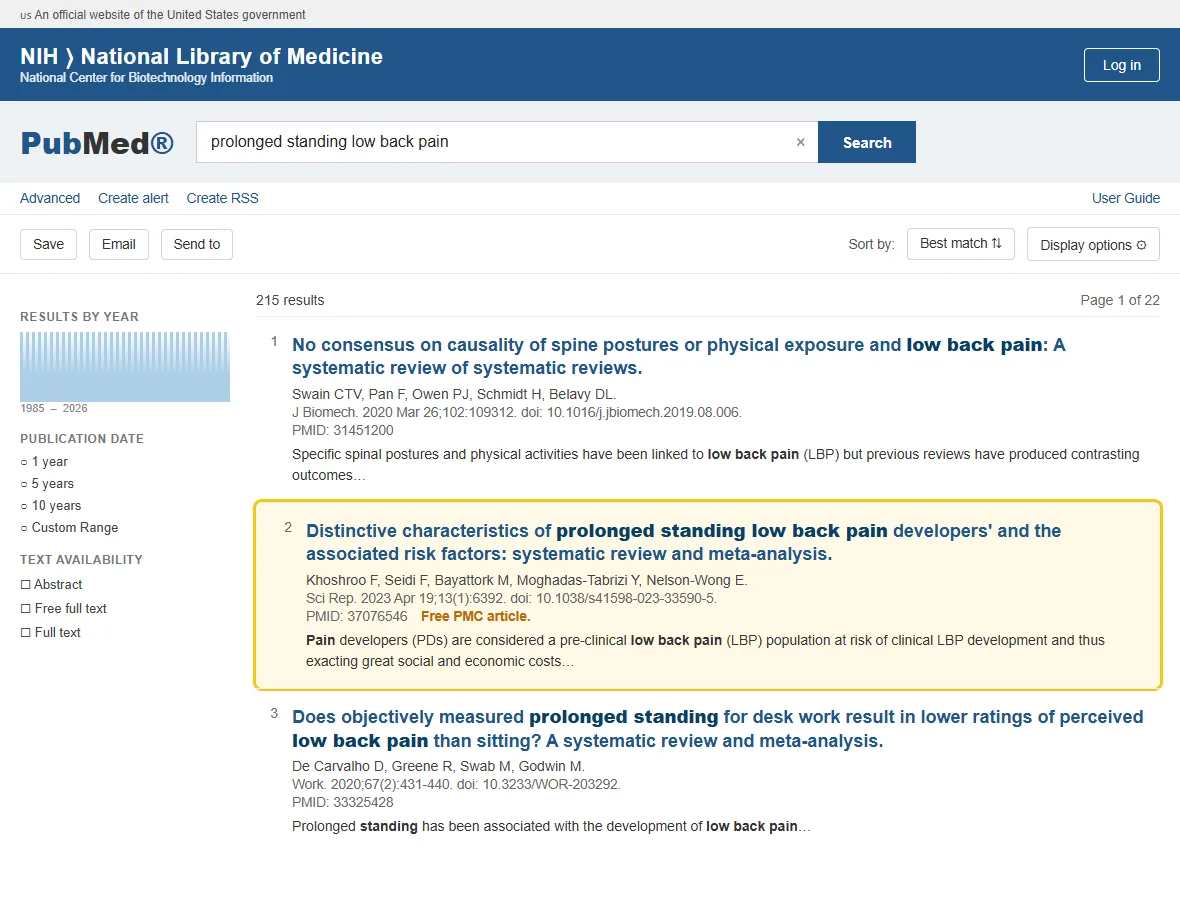
The receipts are public: "prolonged standing low back pain" on PubMed — the meta-analysis behind our numbers is right there. Anyone can verify in ten seconds. That's the point.
The anti-hallucination rules
AI never gets to be the source. It searches and summarizes sources you can check. Concretely: (1) never let a model cite studies from memory — that's how invented citations happen; use a connector or paste the abstract yourself; (2) always verify the PMID exists by opening it on PubMed; (3) if the model says something the abstract doesn't say, it doesn't exist. The division of labor is fixed: the literature is the data. AI is the condenser.
You are my research assistant with access to a scientific-literature
connector (PubMed or similar). My customer avatar:
"[AVATAR — e.g. 'women with lower-back pain from standing all day at
work (nurses, teachers, hairdressers, cashiers)']"
1. Search the published literature for the most plausible physical root
causes of this symptom in this population. Prefer meta-analyses,
systematic reviews and RCTs.
2. For each root cause: explain the mechanism in one plain-English
sentence, and list the supporting studies with title, year, journal
and PMID.
3. Draft a "Unique Mechanism of Problem" (why the pain really happens —
with the most concrete numbers the studies give you: minutes,
degrees, percentages) and a "Unique Mechanism of Solution" (what
would have to change physically to fix the root cause).
4. NEVER cite a study from memory — only studies you actually retrieved
through the connector. If evidence is weak or contested, say so.
I will verify every PMID on PubMed myself before using anything.
Prompt 2 — Abstract → mechanism in plain English + citation
Here is the abstract of a study I pulled from PubMed (PMID: [PMID]):
"[PASTE ABSTRACT]"
1. Explain the finding in plain English, as if to a smart friend. No jargon.
2. What exactly was measured, in whom, and how big is the effect? Quote the
exact numbers from the abstract (including whether they are subjective
self-reports or objective measurements).
3. Write the full citation: authors, year, journal, PMID.
4. Use ONLY what is in this abstract. If something is unclear or missing,
say "not in the abstract" instead of filling the gap.
Prompt 3 — The claim-check (run this before you write)
Based ONLY on the abstract(s) I gave you, I want to write marketing copy.
Act as my strictest co-author:
1. List every claim these studies actually support — phrased as carefully
as the researchers would phrase it (population, conditions, effect size,
subjective vs. objective).
2. List the claims I might be TEMPTED to make that these studies do NOT
support — e.g. acute findings stretched into chronic conditions, one
product category stretched into another, correlation sold as causation.
3. For every unsupported claim, suggest an honest version that survives
scrutiny.
Be strict. If the honest version is weaker, I want the weaker version.
Run Prompt 3 on our worked example and it flags exactly the boundaries in the honesty box above — acute vs. chronic, mats vs. insoles, perceived vs. objective. That's the whole discipline, automated: find the real mechanism in your vertical, and you never need a fake study again.
1.5Build the mothership
Now assemble the advertorial itself: the full belief-shift chain, powered by your study-backed mechanism — on a slightly broader angle. For our example: not "back pain" (too red), and not "nurses with back pain" (not yet — that comes in Step 2), but "back pain from working on your feet all day." Deliberately broad enough that the nurse, the teacher AND the hairdresser can land on it and convert — because your mechanism is about standing, and it's strong enough to convert even very skeptical readers.
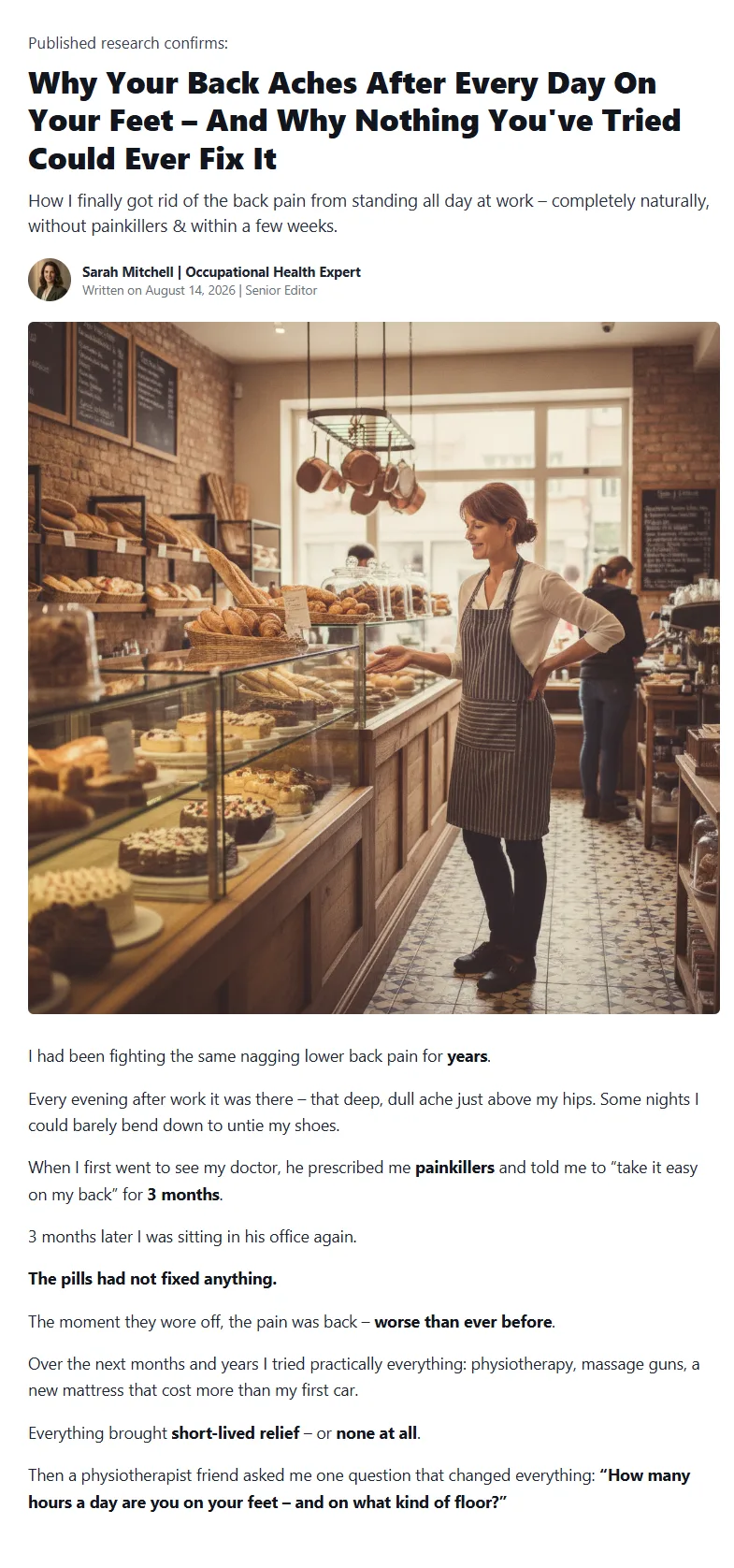
We call this the mothership advertorial. It's your only significant upfront build — a day or two, with AI doing the assembly on top of your research. Editorial look, on its own domain (never the shop — more on that in Step 3). Why "mothership"? Because in Step 2, a whole swarm launches from it.
The mothership: one advertorial on the slightly broader "on your feet all day" angle, carrying the full mechanism. Every micro-audience can land here and convert.
2
Identify & verify your purple ocean.
Break & install ✓ — now aim it. Find the micro-audiences nobody writes for, probe them with cheap ultra-specific ads, and let the market tell you which purple ocean is yours.
2.1One mechanism. Hundreds of purple oceans.
You already built your advertorial and your unique mechanism. Now give both to Claude and ask it for a deep research: which hyper-specific customer avatars are affected by back pain from standing too much? AI will surface purple ocean after purple ocean — more than you could ever probe at once:
Each one: a segment nobody writes for — because until now it was too much work and too risky to find out if it converts.
Prompt 4 — Purple-ocean deep research
Below: (1) my advertorial, (2) my unique mechanism.
Do a deep research: which hyper-specific customer avatars are affected
by [THE PROBLEM — e.g. "back pain from standing too much at work"]?
1. List 15–25 avatars defined by WHO they are and the SITUATION the
pain shows up in (job, life stage, daily context) — not by product
opinions. Hyper-specific ("ICU nurses on 12-hour shifts"), not broad
("healthcare workers").
2. For each: estimated segment size, pain intensity/frequency in their
daily life, and how directly my mechanism applies (does the root
cause match their situation 1:1?).
3. Check for direct competition: does anyone speak to THIS exact avatar
with THIS problem? If yes, who?
4. Also answer: who FEELS the pain vs. who PAYS? (Sometimes the purple
ocean is the buyer — e.g. the daughter buying for her mother.)
5. Rank the avatars into a shortlist of the 5–7 most promising purple
oceans and justify the ranking.
[1 — ADVERTORIAL]
[2 — UNIQUE MECHANISM]
Level 2: ground it in real customer voice
The deep research gives you the map. If you want her actual words for each territory — the raw material your future headlines are made of — mine the voice of your market: product reviews (yours and competitors', especially 2–4 star), Reddit threads where your prospect complains in her own words, comments under competitor ads, one open post-purchase question. Paste it all raw: typos, rants, emojis. The mess is the signal. Then cluster it:
Prompt 5 — Voice-of-customer clustering
I'm pasting [N] raw customer voices below: reviews, Reddit comments,
comments under competitor ads, and post-purchase survey answers. Unedited.
Your job:
1. Cluster these people into segments by WHO they are and the SITUATION
their pain shows up in (job, life stage, daily context) — not by their
opinion of any product.
2. For each segment: a name, the share of voices (%), and the 3–5 exact
phrases they use for their pain — verbatim quotes, do not paraphrase.
3. For each segment: what they've already tried, and how they talk about
why it failed (again: their words).
4. Rank the segments by (a) share of voices and (b) intensity of the pain
language.
Rules: use ONLY the text I pasted. No invented segments, no invented
quotes. Anything under 5% of voices goes into a "long tail" list.
[PASTE RAW VOICES]
The verbatim quotes this returns — "my back is done by hour 10," "9 hours behind the chair" — are your future hooks, headlines and UGC scripts. Language that stops the scroll because she recognizes her own sentence.
2.2Probe: ultra-specific ads for micro-audiences
Now — do NOT write seven ultra-specific advertorials. You'd be guessing which micro-angle wins, and guessing is expensive, even with AI. Instead, you fire ultra-specific static ads at the micro-audiences — the nurse, the teacher, the hairdresser — and every single one points back at that same slightly broader mothership advertorial with your killer mechanism.
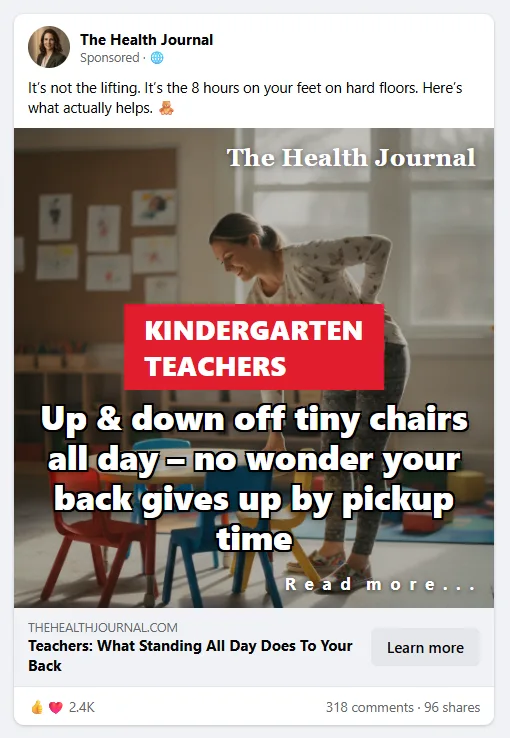
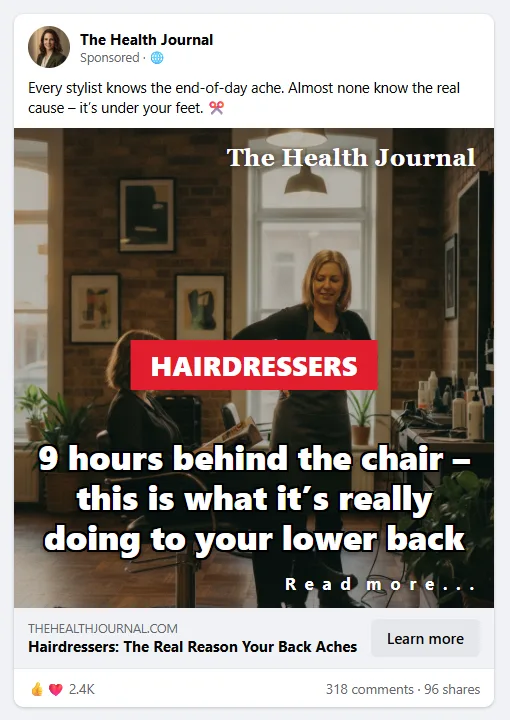
Probe 1: the nurse.Probe 2: the kindergarten teacher.Probe 3: the hairdresser.
View the ads as your cheap little probes — each one testing a purple ocean for a few dollars a day. You're not committing to anyone yet. You're asking the market a question.
Andromeda made this even better
With Meta's Andromeda-era delivery, the creative itself is the targeting: Meta reads each probe's tone and message and delivers it straight to the people it was written for. So when the nurse ad prints, that's not luck — that's the algorithm finding her for you, for a few dollars a day. You don't need interest stacks to reach a micro-audience anymore. You need a message only she recognizes.
2.3Read the data — one angle will print
One of those angles is going to win, because your mothership still converts for all of them. Read the probes in this order: CTR (did her language stop the scroll?), cost per advertorial read (did the click hold?), CAC/ROAS per probe (did it convert downstream?). A probe that wins on all three is a validated purple ocean. And the winning ad tells you more than "nurses won" — it tells you exactly which pain phrasing stopped her scroll. Keep it; it feeds everything in Step 3.
Let's say the nurse ads won. Now comes the genius move.
2.4The one-hour rewrite
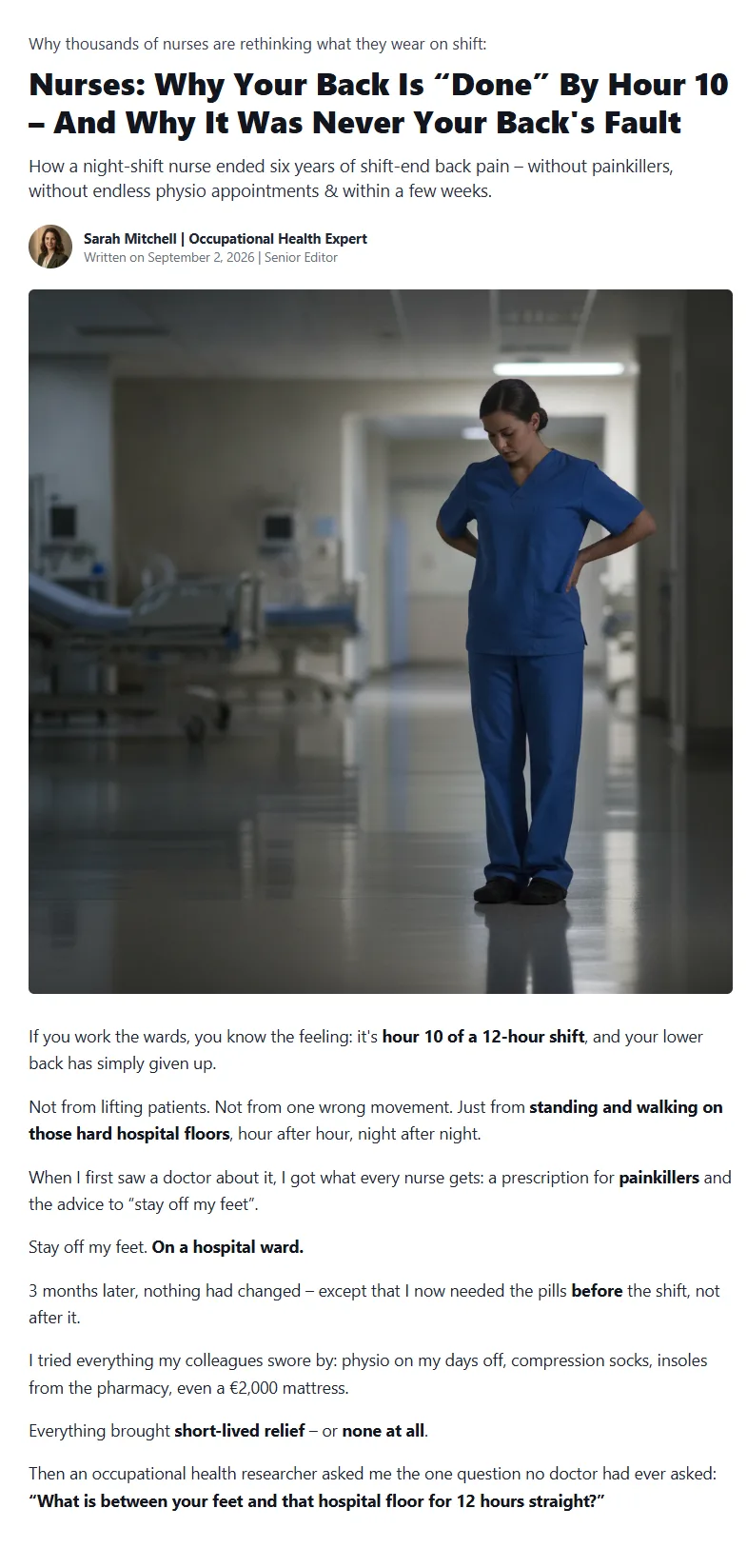
A few months ago, tapping a micro-audience like this was absolute madness — the workload made no economic sense. Now you take the broad mothership and let AI rewrite and completely revamp it solely for your nurse — not just the headline: the root-cause story, the mechanism framing, every example, every scene, first line to last. Give it customer research for the nurse-prospect and it rewrites the whole thing. Before AI: a week of work you'd never invest in one micro-niche. Now: about an hour.
The broad mothership……rewritten for the nurse. Same mechanism, same citations — her world in every line.
The moment you ship it, the nurse sees a funnel so specific, talking so narrowly about her actual life, that she has no choice but to see you as THE expert for her problem. The most niched-down product in the world for her specific pain. Perceived relevance — and with it conversion — jumps.
Prompt 6 — The full editorial rewrite
Below: (1) my current advertorial — the broad "mothership" version,
(2) the winning ad, (3) customer research on the winning segment
(verbatim pain language, daily context, what they've tried).
Rewrite the ENTIRE advertorial for this one segment — headline to last
line. Rules:
1. Keep the chain intact: PROBLEM → FAILED SOLUTIONS → ROOT CAUSE →
MECHANISM → OFFER. Do not skip, merge or reorder links.
2. Keep every study citation and every number EXACTLY as it is. You may
reframe the story around them; you may not touch them.
3. Replace every generic example, scene and daily detail with this
segment's world — use their vocabulary from the research below.
4. The advertorial starts where the ad ends: assume she has just read the
ad. Do not repeat its pain-opening — deepen it and move to the next
link of the chain.
5. No hype, no invented urgency, no claims beyond the cited studies.
[1 — MOTHERSHIP ADVERTORIAL]
[2 — WINNING AD]
[3 — SEGMENT RESEARCH + VERBATIM QUOTES]
Then read the output against your citations file before shipping — rule 2 gets checked by you, not trusted. (Prompt 3 works on finished copy too: paste the rewrite and your abstracts, and let it flag any claim that drifted.)
The principle behind the whole loop
Your advertorial starts where your ad ends. The ad and the advertorial are ONE chain split across two assets: the ad runs the first links (the problem, the first failed solutions), the advertorial picks up exactly there. That's why the probes are cheap and swappable while the expensive asset behind them stays constant — and why the rewrite (rule 4 above) never repeats the ad's opening.
3
Start the engine.
Break & install ✓ · Purple ocean verified ✓ — congratulations, you now own an audience your competition doesn't even think about. Time to put the pedal to the metal. This is where it gets almost unfair.
3.1Pile onto the validated angle
The angle is VALIDATED now. You know it converts. So you double down on it — every asset type, all aimed at the same target:
A fresh ad set of statics — all on the nurse angle, each built from the pain phrasing the probe surfaced.
A video sales letter — scripted from the exact language of the winning probe and your mechanism.
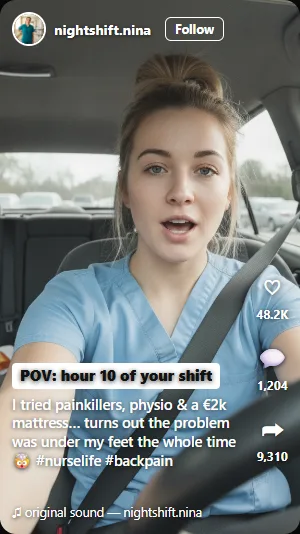
UGC creators — briefed on the same angle: "POV: hour ten of your shift."
Social proof, cartoon ads, advertorial variations — whatever formats work in your account, now with zero angle-risk.
The VSL — scripted from the validated angle.UGC — briefed on the same angle.
Most people test creatives hoping to stumble onto an angle. You already found the angle — your creatives just multiply it. Every asset is aimed at a target you've already hit once, which means you take almost no risk investing time and money into these purple-ocean audiences.
3.2What happens to your numbers
Once you're the only one actually speaking directly to your purple ocean, the numbers start moving in every direction at once:
↓ CPC
Click costs drop
Her ad finally feels like it's about HER — she stops scrolling and clicks.
↓ CAC
Acquisition cost drops
First-click conversion — she buys instead of comparison-shopping ten identical offers.
↑ AOV
Order value rises
Experts don't sell the cheapest bundle. A prospect who feels understood buys the full solution.
You're the only one in her feed who obviously understands her job. Relevance is the cheapest performance lever almost nobody in your market is pulling, because almost everyone is pointing AI at "more," not "deeper."
The two boring foundations (that make the data trustworthy)
Every advertorial lives on its own editorial domain — never the shop. Credibility: an editorial page on a shop domain reads as what it is, an ad; on its own domain it reads as content. Tracking: a dedicated domain gives you a clean funnel stage you can measure probe by probe.
Keep cross-domain tracking clean. When traffic hops ad → advertorial domain → shop, your click IDs and UTM parameters must survive every hop into checkout — otherwise "read the data" reads noise and the engine optimizes on fiction. Set it up once, verify it in a real browser before scaling spend, re-verify whenever you add domains.
3.3Rinse & repeat — the moat
Then you do it again. And again. One purple ocean after another, each with its own probe-validated advertorial you can rewrite and ship within an hour. Run this for a few months and you've claimed five, six, seven micro-niches — with hyper-specific dedicated funnels — before your competition notices even one.
And when they finally do? It takes them weeks to notice WHAT you're doing, and months to understand the SYSTEM behind it. From the outside they see one ad. They can't see the research, the probes, the citations file, the rewrite loop. By the time they've reverse-engineered one funnel, you're four niches further and the established name in every one of them.
That's a structural moat, not a campaign edge.
Equipment
The tool stack — honest version
No affiliate links, no hype. The system is tool-agnostic almost everywhere; here's what each job needs and what we actually use.
Job
Tool
The honest note
Study research
Claude + a scientific connector; PubMed (pubmed.ncbi.nlm.nih.gov), Google Scholar
The connectors pull real literature straight into the chat. PubMed for anything body/health-adjacent; Scholar for everything else (materials, psychology, energy, pets). Verify every PMID yourself — the connector finds, you check.
AI writing & research
Any frontier LLM — Claude, ChatGPT, Gemini
The model matters far less than what you feed it. All six prompts on this page work on any of them. The edge is your research + customer-voice corpus, not the logo on the chatbot. Keep a structured knowledge base (citations file, avatar research, mechanism write-up) and give it to every session.
Voice-of-customer harvesting
Platform ad libraries, Reddit search, review pages, one open-ended post-purchase question
Manual copy-paste is fine at the start; an hour of collecting beats any scraping tool you'd spend a day configuring. Volume > tidiness.
Creative image generation
Nano Banana (Gemini image gen), GPT-Image
For editorial visuals and static ad imagery. Same honesty bar as the copy: no fake before/afters, no fabricated "lab" shots. Illustrative scenes, product-in-context, diagrams.
Advertorial hosting
Funnelish (what we use) — or any page builder that lets you use a dedicated domain
The requirement is the dedicated editorial domain and fast edits for the rewrite loop, not a specific vendor.
Tracking
Cross-domain parameter pass-through (click IDs + UTMs), server-side where possible; an attribution tool once you scale
The unglamorous foundation. If ad → advertorial → shop loses parameters, your probe data lies to you. Test the full hop in a real browser before trusting any number.
Total stack cost at the start: essentially your AI subscription. The moat isn't in the tools — it's in the discipline of the research and the loop.
Recap
Three things to take home
01
TRUTH converts.
Break the old belief, install a new one — and truly convince your audience with science. With AI, fact-based is now the EASY path, and your angles, ad accounts and payouts all live longer for it.
02
PURPLE beats red.
AI collapsed the production cost. The micro-niches your competition ignores are now your most profitable oceans.
03
PROBE, then commit.
Ads test. Advertorials follow. One broader mothership, a swarm of ultra-specific probes — and every winner gets its own funnel and its own creative stack.
And if the talk felt persuasive — notice what happened to you. Problem, failed solutions, root cause, mechanism, proof. You watched the chain run on yourself. That's the Purple Ocean Engine.
Appendix
Every study behind every number
"No source, no sentence." Here is the full evidence chain. Every PMID opens on PubMed — verify anything in ten seconds.
A. Standing → acute low-back pain (the dose)
Coenen P, Parry S, Willenberg L, et al. (2017). Associations of prolonged standing with musculoskeletal symptoms — a systematic review of laboratory studies. Gait & Posture 58:310–318.PMID 28863405
Clinically relevant low-back symptoms after ~71 minutes of continuous standing (average); authors recommend not standing longer than ~40 min at a stretch.
Khoshroo F, Seidi F, Bayattork M, et al. (2023). Distinctive characteristics of prolonged-standing low back pain developers — systematic review & meta-analysis. Scientific Reports 13:6392.PMID 37076546
"Pain developers" reach symptoms after ~42 minutes; 31–80% of participants develop standing-induced low-back pain. Evidence supports postural (lordosis) mechanisms over muscle fatigue.
B. The root cause (posture, not bad luck)
Sorensen CJ, Norton BJ, Callaghan JP, Hwang CT, Van Dillen LR (2015). Is lumbar lordosis related to low back pain development during prolonged standing? Manual Therapy 20(4):553–557.PMID 25637464
Pain developers stand with ~4.4° more lumbar lordosis (95% CI 0.9–7.8; d=0.7); lordosis correlates with maximum pain (r=0.46, p=0.02).
C. Why the standard solutions miss
Mattila VM, Sillanpää P, Salo T, et al. (2010). Orthotic insoles do not prevent physical stress-induced low back pain. European Spine Journal 20(1):100–104.PMID 20602123
RCT: back-pain incidence 33% with orthotic insoles vs. 27% control (p=0.37) — insoles "not recommended to prevent physical stress-related low back pain."
Note the logic discipline: painkillers, physio and mattresses "missing the root cause" is a mechanism argument (they act after the exposure, not during it) — there are no head-to-head RCTs to cite for those, so we argue it as logic, not as "studies prove they fail." Only the insole claim has direct trial evidence.
D. The mechanism solution (cushioned ground)
Winberg TB, Glinka MN, Gallagher KM, Weaver TB, Laing AC, Callaghan JP (2022). Anti-fatigue mats can reduce low back pain in transient pain developers. Applied Ergonomics 100:103661.PMID 34837750
In pain developers: reported LBP 3.6±6 mm on a cushioned mat vs. 6.8±7 mm on hard floor (p=0.03) → ~47% reduction in perceived pain. No effect in non-pain-developers.
Aghazadeh J, Ghaderi M, Azghani MR, et al. (2015). Anti-fatigue mats, low back pain, and electromyography. Int J Occup Med Environ Health 28(2):347–356.PMID 26182929
Mats significantly reduced subjective low-back pain; no objective EMG change; 73% of workers preferred the mat.
E. The boundaries (what the evidence does NOT say)
Swain CTV, Pan F, Owen PJ, Schmidt H, Belavy DL (2020). No consensus on causality of spine postures or physical exposure and low back pain. Journal of Biomechanics 102:109312.PMID 31451200
"No consensus regarding causality" for spine posture/exposure and (chronic) low back pain — the reason we sell the acute, daily problem only.
Jahn A, Andersen JH, Christiansen DH, Seidler A, Dalbøge A (2023). Occupational mechanical exposures as risk factors for chronic low-back pain — systematic review & meta-analysis. Scand J Work Environ Health 49(7):453–465.PMID 37581384
Non-neutral postures: OR 1.5 (1.2–1.9); combined exposures: OR 2.2 (1.4–3.6); standing/walking alone: OR 1.0 (0.8–1.3) — no association with chronic LBP. The odds ratios belong to posture; never quote them for "standing."
Claims discipline — the summary card
✓ Acute standing pain within ~71 min (42 min in the susceptible) — Coenen, Khoshroo
✓ ~4.4° extra lordosis separates pain developers from non-developers — Sorensen
✓ Cushioned ground ≈ −47% perceived pain in pain developers — Winberg (subjective; supported by Aghazadeh)
✓ Standard orthotic insoles failed to prevent stress-induced LBP in an RCT — Mattila
✗ "Standing causes chronic back disease" — contested (Swain; Jahn: standing alone OR 1.0)
✗ "Insoles halve back pain" — the −47% is mats/cushioning, not insoles
✗ Venous pooling or pure muscle fatigue as the root cause — evidence points to posture (Khoshroo)
What's next
You have the whole engine. Two ways to run it.
Option A — run it yourself. Everything you need is on this page: the prompts, the workflow, the citations. Start with your vertical's biggest red-ocean pain and let the market answer. Your first probe can be live within days.
Option B — talk it through. If you're too busy to run the engine yourself and you'd rather have someone do it for you — or you simply have questions about the framework — feel free to grab a slot in my calendar anytime. We'll talk shop, and if it turns out working together makes sense, great. If not, you leave with your questions answered.
This page is free and ungated on purpose. If it sharpened how you think about advertorials, send the link to the one media buyer who needs it. That's the whole ask.